

When I started writing my first science-fiction novel, I wasn’t thinking about character profiles, story bibles, or any of the other tools that fiction writers use to organize their stories. I just opened Google Docs, created a new document, and started writing the first chapter. I had an idea for the world, a few characters in mind, and a pretty good understanding of where I wanted the story to go. At the time, I thought that was more than enough. And for the first few chapters, it actually was.
But things started getting complicated as I introduced more characters, locations, events, and relationships. I used Google Docs’ Comments feature to keep notes about specific characters and important details, and eventually created separate documents to organize everything. Somewhere around the sixth or seventh chapter, I realized that remembering every little detail about my fictional world was becoming almost as challenging as writing the story itself. I needed a better way to organize my characters, and that’s when I started understanding why character profiles are so useful.
The thing about writing a novel is that you can remember everything about a character when you first create them. Their appearance, personality, motivations, relationships, and even the smallest details about their past are still fresh in your mind. But what happens when you’ve written another 50,000 words, introduced 20 more characters, and spent months working on different chapters? Trust me, you won’t remember every detail, and you shouldn’t have to.
In this guide, I’ll explain how to create a complete character profile, what information is worth including, and how to actually use those details while writing your novel. I’ve also prepared a free Character Profile Template, which you can download in PDF, Word, or Markdown format.
What is a character profile?
A character profile, sometimes called a character sheet, is a document containing important information about a fictional character. It can include anything from their name, appearance, and background to their personality, fears, goals, relationships, and development throughout the story. Think of it as a reference page that you can open whenever you need to remember something about a particular character.
For example, imagine introducing a character in Chapter Three who has a scar across their left eyebrow. You describe how they got it, perhaps during an accident when they were younger, and then continue writing your novel. Twenty chapters later, that same character appears again, but this time you accidentally describe the scar above their right eyebrow. It’s a small detail, but attentive readers may notice it.
Now imagine that instead of a scar, the inconsistency involves something much more important, such as a character’s age, their relationship with another character, a traumatic experience from their childhood, or a secret they’re not supposed to know about yet. A character profile helps you avoid these mistakes by keeping important information in one place.
But there’s another reason why I find them useful: they encourage you to think about your characters as actual people instead of simply giving them a name and a purpose in the story.
Why should you create character profiles?
Not every writer needs a detailed character profile, and you certainly don’t need to spend hours answering questions before you can start writing. Some authors prefer planning everything beforehand, while others discover their characters as they write. Both approaches are perfectly fine.
Personally, I think character profiles become more valuable as your story grows. If you’re writing a short story featuring two characters, you probably don’t need six pages of information about each one. But if you’re writing a science-fiction or fantasy novel with multiple locations, factions, complicated relationships, and a large cast of characters, having some kind of organized reference system can save you a ridiculous amount of time.
There are several practical reasons to create them.
You won’t have to remember everything
I think this is the most obvious benefit, especially when working on a long manuscript. You can quickly check a character’s appearance, age, occupation, background, or relationships without searching through dozens of chapters or old notes.
It’s also useful when you return to your novel after taking a break. Instead of rereading thousands of words to remember what you decided about a character months ago, you can open their profile and refresh your memory.
Your characters can become more believable
A believable character needs more than a name, an interesting appearance, and a tragic backstory. They need something they want, something they’re afraid of, personal weaknesses, and reasons behind the decisions they make.
A character profile encourages you to ask questions you might otherwise overlook. Why does this person behave a certain way? What are they trying to achieve? What would make them abandon their beliefs? What happens when they’re forced to choose between two things they care about?
You might never reveal every answer to your readers, but knowing those answers yourself can make a difference in how you write the character.
You can avoid continuity mistakes
Continuity mistakes are particularly frustrating because they can be difficult to spot when you’re the person writing the story. Let’s say a character mentions that they have never visited a certain city. Later in the novel, you accidentally write a scene where they remember spending their childhood there. Unless there’s a deliberate explanation, you’ve created a contradiction.
Keeping track of established facts, important events, and what each character knows can help prevent these problems.
It’s easier to manage larger casts
When you’re dealing with a handful of characters, keeping track of everyone is relatively simple. But once you introduce families, friends, enemies, organizations, and characters who only appear occasionally, things can become messy.
This is especially true if you’re planning a book series. A secondary character from your first novel might become important in the third book, and you’ll want their history and established personality to remain consistent.
How to create a character profile: 6 Essential sections
There’s no universal rule about what a character profile should contain. Some authors prefer detailed documents that cover almost every aspect of a character’s life, while others only write down the information that’s relevant to their story. For the free template I’ve created, I divided everything into six sections. These cover the information I consider most useful when developing and managing fictional characters.
1. Basic information and story role
Let’s start with the obvious things. Every character profile needs some basic identifying information, including their name, age, background, occupation, and role in the story. But instead of simply filling out these fields, try thinking about how each detail affects the character’s behavior or circumstances.
For example, a character’s occupation could explain why they’re particularly good at solving technical problems, while their background might influence how they respond to authority. Their age could affect their experience, responsibilities, or physical limitations, depending on the story you’re writing. You should also consider their role in the novel. Are they the protagonist, antagonist, mentor, supporting character, or someone whose true importance isn’t immediately obvious?
Another interesting question is what readers will initially think about them. A character might appear confident, wealthy, and successful, while secretly struggling with feelings of inadequacy. That contradiction gives you something to explore beyond the character’s appearance. Don’t worry about completing every field immediately. Start with what you know and return to the rest when you have a clearer understanding of the character.
2. Goals, Motivations, and Stakes
This is where things start getting interesting. Every important character should have something they want, even if that desire has nothing to do with the main conflict of your novel. It might be something simple, such as getting a promotion, or something much bigger, such as saving their family, uncovering a conspiracy, or escaping a dangerous world.
But knowing what a character wants isn’t quite enough. You should also understand why they want it. Imagine two characters who are both trying to become the leader of a powerful organization. One wants the position because they genuinely believe they can improve people’s lives. The other wants it because they’ve spent their entire life feeling powerless and are terrified of losing control again. They share the same objective, but their motivations couldn’t be more different. As a result, the decisions they make throughout the story will probably be very different too.
I also like separating a character’s external goal from their deeper emotional need. Their goal might be to gain power, while what they actually need is to learn how to trust other people. Their goal might be to find a missing family member, while their emotional need is to confront the guilt they’ve been carrying for years. You don’t have to give every character a life-changing psychological journey, but understanding these differences makes it easier to write meaningful conflicts.
One more thing worth considering is what happens if they fail. If there’s nothing meaningful at stake, readers might have a difficult time caring about whether your character succeeds.
3. Fears, Flaws, and Contradictions
I don’t find perfect characters particularly interesting. In fact, some of the most memorable fictional characters are the ones who make terrible decisions for reasons that make complete sense to them. That’s why I think fears and flaws deserve their own section.
A fear doesn’t necessarily have to involve something obvious, such as heights, spiders, or death. A character might be terrified of being abandoned, losing control, disappointing their family, or discovering that everything they believe is wrong. These fears become much more interesting when they influence the character’s decisions.
For example, someone who’s afraid of abandonment might become overly controlling in their relationships. They may believe they’re protecting the people they love, when their behavior is actually pushing those people away. That’s a flaw with consequences, which is considerably more useful than simply writing “controlling” in their character profile.
You can also explore contradictions. Someone can be incredibly brave in dangerous situations but completely incapable of expressing their feelings. Another person might be generous toward strangers while treating their own family terribly. Real people aren’t always consistent, and fictional characters don’t have to be either. What matters is that their contradictions make sense within their personality, experiences, and circumstances.
4. Backstory and Important Life Events
A character’s backstory explains what happened before the events of your novel. It might include their childhood, family, important relationships, education, traumatic experiences, or decisions that changed their life. But here’s something I’ve learned while working on complex fictional worlds: just because you’ve created an interesting piece of backstory doesn’t mean it needs to appear in your manuscript.
You might write three pages explaining a character’s childhood, only to realize that readers need to know two or three important details. That’s perfectly fine. The rest can remain in your private notes. The purpose of a character profile isn’t to force every piece of information into the novel; it’s to help you understand the character well enough to write them consistently.
Instead of documenting every year of their life, start with the events that shaped who they are today. What happened? How did they interpret that experience? Did it teach them something valuable, or did they learn the wrong lesson?
Sometimes, the most interesting part of a backstory isn’t what happened, but what the character believes happened. A character who thinks they were betrayed by a close friend might spend years seeking revenge, only to discover that their understanding of the event was completely wrong. Suddenly, something that happened long before the novel began becomes relevant to the present story.
5. Personality, Voice, and Relationships
One of the challenges of writing multiple characters is making sure they don’t all sound and behave exactly the same. You can give everyone different names and appearances, but if they speak in the same way, react similarly to every situation, and share identical opinions, they may start feeling interchangeable.
Consider how your character communicates. Are they direct and confident, or do they carefully choose their words? Do they use humor when they’re uncomfortable? Do they avoid answering personal questions? What happens to their behavior when they’re angry or frightened? These details don’t need to be exaggerated. Sometimes, the smallest habits can make a character feel recognizable.
Relationships are equally important. A person might behave very differently around their closest friend than around someone they deeply distrust. Their personality doesn’t necessarily change, but different relationships reveal different sides of it. This becomes very useful when writing disagreements, romantic relationships, rivalries, friendships, or conflicts between family members.
Try to think about what each character expects from the other. What do they misunderstand about one another? Is there an important secret between them? Does one person depend on the other more than they’re willing to admit? Questions like these can help you create relationships that evolve naturally instead of remaining exactly the same throughout the novel.
6. Character Development and Continuity
Finally, we have character development, also known as the character arc. A character arc describes how someone changes, or refuses to change, because of what happens throughout the story. Their experiences, decisions, relationships, and failures can challenge the beliefs they had at the beginning.
For example, think of a character who believes that trusting others will always lead to betrayal. Throughout the novel, they’re repeatedly forced into situations where they cannot succeed alone. By the end, they might finally accept that trusting someone involves taking a risk.
Of course, they could also make the opposite decision. Perhaps their experiences reinforce their beliefs and they become even more isolated than before. Not every character arc needs to end positively. What matters is understanding where your character begins, what challenges them, and where they eventually end up.
I also recommend keeping a small section for continuity notes. This is where you can record details that shouldn’t unexpectedly change between chapters, such as a character’s appearance, abilities, established relationships, important promises, injuries, and knowledge of particular events. You can update these notes while writing instead of trying to predict everything in advance.
A Character Profile Example
Let’s put some of these ideas into practice. Imagine we’re writing a science-fiction novel set in a floating city where most historical records are controlled by the government. The protagonist discovers that entire sections of the city’s history have been deliberately erased. We could create the following character.
Character: Mara Venn
Basic Information: Mara is a 32-year-old municipal archivist who works in the city’s central records department. She’s intelligent, observant, and exceptionally good at identifying inconsistencies in historical documents. She lives with her younger brother and has spent most of her adult life trying to give him a stable future.
Goal: Mara wants to recover a missing evacuation record that might explain why thousands of citizens disappeared decades earlier. She initially believes that finding the document will be enough to expose the truth.
Motivation: Her father was accused of falsifying government records when she was a child. Mara has always believed he was innocent, and recovering the missing information could finally prove it.
Greatest Fear: Losing her brother. After her father’s disappearance and her mother’s death, protecting him became the most important responsibility in her life.
Main Flaw: Mara struggles to trust other people. She keeps important information to herself, believing that involving others would put them in danger. Unfortunately, this also prevents people from helping her when she needs it most.
Backstory: As a teenager, Mara secretly discovered that her father had hidden copies of several classified documents. She destroyed them because she believed they were dangerous, a decision she has regretted ever since.
Relationships: Her brother admires her but increasingly resents how much she controls his life. She also develops a complicated friendship with a government investigator who appears to be helping her, although neither character is completely honest about their intentions.
Character Arc: Mara begins the story believing that protecting someone means keeping them away from danger, even if it requires lying to them. As the story progresses, she’s forced to confront the consequences of withholding information. Eventually, she must decide whether to reveal the truth to her brother and accept that she cannot control every decision he makes.
That’s already a decent foundation for a character.
We know who Mara is, what she wants, why it matters, and which personal weaknesses might create problems throughout the story. We also have several opportunities for conflict, especially when her desire to uncover the truth clashes with her need to protect her brother. And we haven’t even started writing her first scene yet.
The important thing to understand is that this profile shouldn’t restrict us from developing Mara differently as the story progresses. We might discover something more interesting about her personality while writing a particular chapter, or decide that her relationship with the investigator needs to change. That’s perfectly normal. A character profile is a working document, not a contract you have to follow for the rest of your novel.
Common mistakes to avoid when creating character profiles
One mistake I would avoid is spending more time creating character profiles than actually writing the story. It’s surprisingly easy to fall into this trap, especially when you’re developing a complicated fictional world with dozens of interesting details. You start by writing down a character’s age and appearance, and before you know it, you’ve spent an entire afternoon deciding what their favorite food is, which music they listen to, and what their childhood bedroom looked like.
There’s nothing inherently wrong with exploring those details, especially if you enjoy worldbuilding. But you should ask yourself whether the information is helping you understand the character or simply giving you another reason to postpone writing.
Another mistake is creating a profile and never updating it. Characters often develop in unexpected ways. You might introduce an important relationship that didn’t exist in your original outline, discover a better motivation for a particular decision, or change an event in their backstory. When that happens, update the profile so it continues reflecting the story you’re actually writing.
Finally, try not to confuse having a detailed profile with having a well-written character. A six-page document can help you understand someone, but readers still need to see that character make decisions, interact with other people, struggle with problems, and experience meaningful consequences. The profile supports your writing. It doesn’t replace it.
Download the Free Character Profile Template
To make the process easier, I’ve created a free Character Profile Template specifically for fiction writers. It’s organized into the six sections covered in this guide, with guided questions designed to help you think more deeply about your characters. Instead of simply asking for basic information, the template encourages you to explore motivations, internal conflicts, relationships, formative experiences, and character development.
You can use it for protagonists, antagonists, supporting characters, or anyone else who plays an important role in your novel.
The template is available in three formats:
- PDF: A printable six-page worksheet with space for handwritten answers.
- Word (.docx): An editable version that works with Microsoft Word, Google Docs, and compatible document editors.
- Markdown (.md): A simple, editable version for Obsidian and other Markdown-based applications.
All three versions are completely free, and you don’t need to create an account or provide your email address to download them.
You can complete the entire worksheet before writing your first chapter, or fill it out gradually as your characters develop. I personally think the second approach is worth considering if you’re someone who enjoys discovering the story while writing it.
How I organize characters with The Novelist
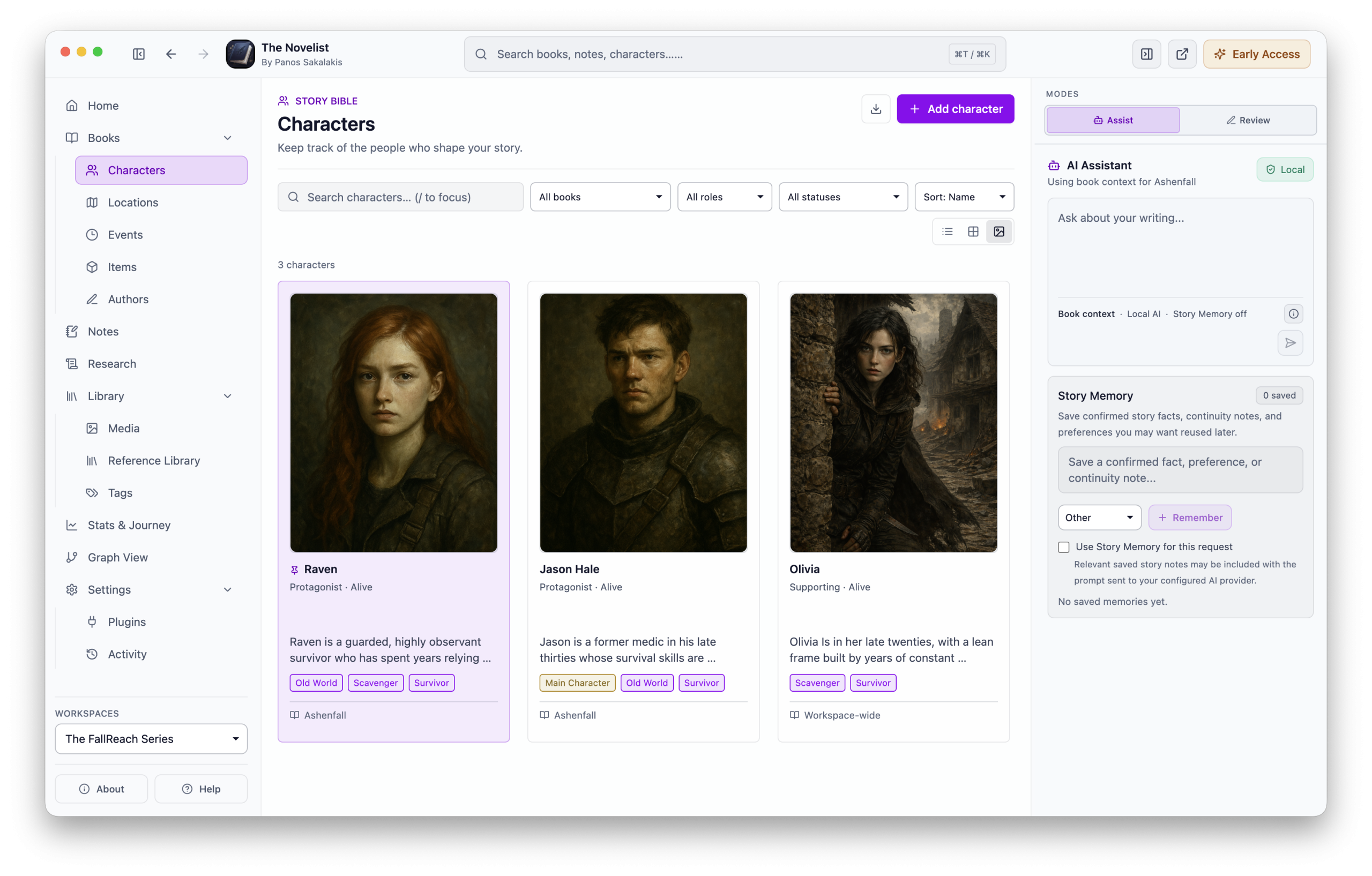
After spending years writing my first science-fiction novel and experimenting with different ways to organize my manuscripts and worldbuilding notes, I eventually started developing The Novelist, a desktop writing application designed specifically for fiction writers.
One of the problems I wanted to solve was having to jump between different documents and applications just to find information about something I’d already written.
I wanted my chapters, characters, locations, organizations, and other important story details to live together in one workspace, instead of being scattered across Google Docs files, comments, and separate notes.
With The Novelist, you can create individual character entries inside your project’s Story Bible and keep their information alongside the rest of your story. You can also connect related story elements, which becomes particularly useful when you’re working with multiple characters, locations, and organizations.
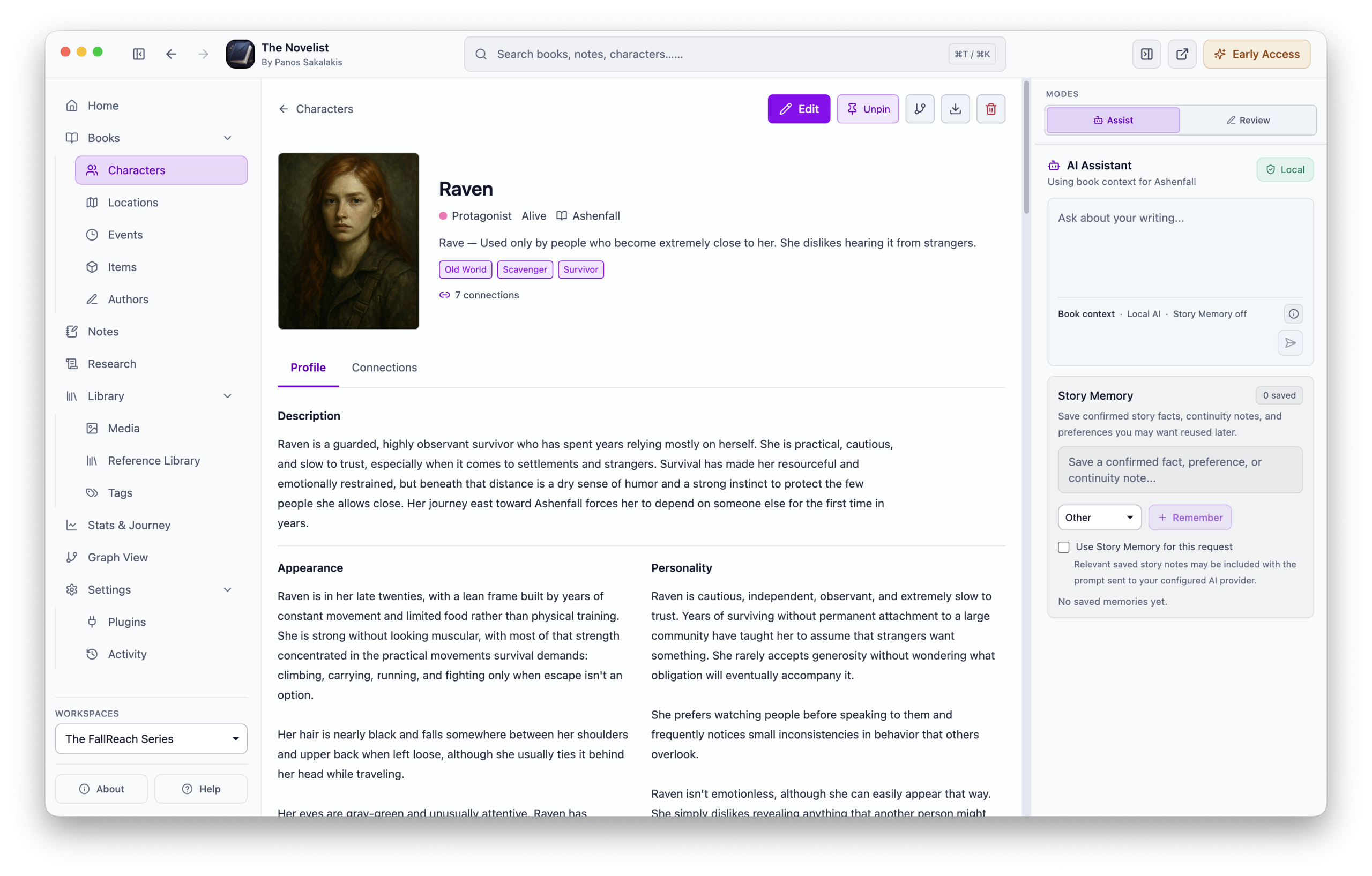
For example, instead of searching through different documents to remember which organization a character belongs to or which people they’re connected to, you can keep those relationships organized within your writing workspace.
The application is also built around a local-first approach, meaning your writing is stored on your own device rather than requiring you to keep your manuscript on somebody else’s server.
And you don’t have to pay to start using it. The Novelist has a Free edition, so you can explore its writing and worldbuilding features without committing to a subscription.
You certainly don’t need The Novelist to use the character profile template from this article. The worksheet works perfectly well on its own, whether you prefer Google Docs, Word, Obsidian, or traditional pen and paper.
But if you’re planning a longer novel or book series and want a more organized place for your characters and story information, it’s another option worth exploring.
Frequently Asked Questions
How long should a character profile be?
There’s no required length. Some characters might need only a few paragraphs, while important characters in a complex novel could benefit from several pages of information. I recommend starting with the essentials, particularly their role, goals, motivations, fears, and important relationships, and expanding their profiles whenever necessary.
Do I need a character profile for every character?
Not necessarily. Your protagonist and other important characters will probably benefit from more detailed profiles, but a minor character who appears in a single scene might only need a name, a short description, and a few relevant details. Use as much information as your story actually requires.
Should I create character profiles before writing my novel?
You can, but you don’t have to. If you’re a planner, creating profiles beforehand may help you understand your characters and develop your outline. If you prefer discovering your story while writing, you can begin with basic information and gradually build the profiles as new details emerge.
What’s the difference between a character profile and a character arc?
A character profile describes who your character is, including their background, personality, motivations, flaws, and relationships. A character arc focuses specifically on how that character changes, or remains unchanged, throughout the story. The character arc can be one section of a larger profile.
Can I use the same character profile across multiple books?
Absolutely. In fact, keeping a character profile becomes even more useful when writing a series because you need to maintain consistency between books. You can continue updating the profile as the character experiences new events, builds relationships, and develops over time.
Can I use the free template in Obsidian or Google Docs?
Yes. The Markdown version is suitable for Obsidian and other Markdown editors, while the Word version can be opened and edited in Google Docs. The PDF is designed primarily for printing. The formats are independent of The Novelist, so you can use whichever application works best for you.
Final thoughts
Creating character profiles might initially feel like another task you need to complete before you can start writing your novel. But I think it’s better to look at them as something that makes the actual writing process easier, especially when your fictional world starts growing beyond what you can comfortably remember.
You don’t need to know every little thing about your characters, and you definitely don’t need to answer hundreds of questions about their personal lives. Start with the information that matters to your story, give them believable motivations and weaknesses, and let them develop naturally as you write.
And whenever you discover something new about them, write it down. You’ll appreciate having those details available when you’re 80,000 words into your manuscript and suddenly need to remember something you decided six months earlier.
Happy writing!
Leave a Reply